Edward Elgar — In Review Sept 11, 2026 SEAM + Seven Bs Ghost Vortex Capture
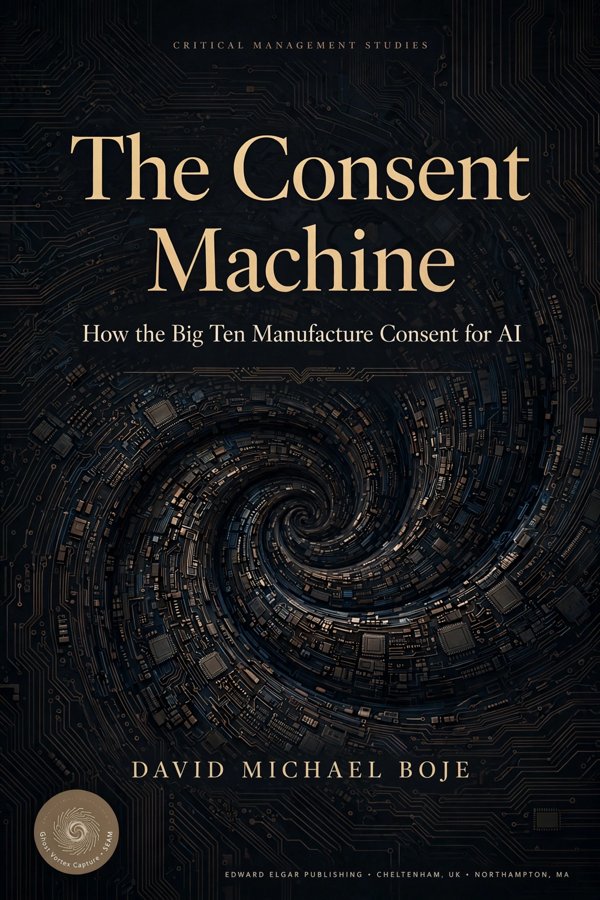
The Consent Machine cover

The Consent Machine:
How the Big Ten Manufacture Consent for AI

The ten largest consulting firms by revenue — Deloitte, Accenture, PwC, EY, McKinsey, KPMG, BCG, IBM Consulting, Booz Allen Hamilton, and Bain — have invested more than $10 billion in AI since 2023. This book reveals how they manufacture consent for AI through transactional consulting, hidden costs, and the Ghost Vortex — the architectural reproduction of dark-side character in every product and practice.

By David Michael Boje, PhD, Distinguished Professor Emeritus, NMSU · In review at Edward Elgar Publishing as of September 11, 2026 · Concepts and methods for Ghost Vortex Capture worked out here.

Book Summary — 500 Words

Why AI-Driven Change Has Run Off the Rails — And How the Big Ten Manufacture Consent for It

The United States AI consulting market will exceed $15 billion in 2026. Accenture alone has 77,000 AI professionals and a $3 billion commitment. Deloitte has invested $3 billion through 2030 and credentialed 25,000 professionals. PwC's ChatPwC has 200,000 internal users. McKinsey's Lilli processes over half a million prompts monthly. These figures are not just investment; they are a bet that AI will restructure management consulting as thoroughly as the mainframe did in the 1960s and ERP did in the 1990s.

The Consent Machine does not dispute scale. It disputes model. The dominant model is transactional, instrumental, and means-justifying-ends: AI sold as product, implemented as technology project, measured by short-term efficiency, billed at hourly or project rates that systematically obscure social and organisational costs. This is consulting model SEAM was developed to replace.

Drawing on Henri Savall's Socio-Economic Approach to Management (SEAM) developed since 1974 at ISEOR Lyon with Véronique Zardet, Marc Bonnet, and Amandine Savall — tested in 2,000+ organisations, 72 sectors, 46 countries, 110,000+ people — and Boje's antenarrative theory and Ghost Vortex construct, book develops four contributions:

(1) SEAM-derived methodology for assessing AI consulting. Five-step qualimetric assessment: dysfunction identification via mirror effect (presenting organisation's own dysfunctions back in its own words), hidden cost computation using five indicators (absenteeism, turnover, defective work, direct productivity gaps, non-creation of potential) extended to AI rework (40% productivity loss), Shadow AI breach exposure ($4.74M avg IBM 2025), abandoned pilots (46% scrapped), fee overruns (68% exceed budget 42% avg), dependency. HORIVERT intervention design (horizontal organisation-wide + vertical team-level), qualimetric measurement over time, antenarrative audit using Seven Bs.

(2) Contrast tables and hidden cost computations. Transactional vs SEAM-grounded across eight dimensions. Illustrative computation shows visible consulting fees $1.5–$3M per major engagement represent ~37% of real total cost; hidden costs exceed visible by more than 100% and are borne entirely by client. Government dimension: Pentagon $32B contract ceiling first half FY2026, federal cohort lost $20B+ early 2026 (Deloitte 129 contracts $372M, Accenture $240M, Booz Allen $207M), intensifying push into military AI.

(3) Ghost Vortex Capture. Three-layer ideological formation: Layer One founder values in training data, Layer Two RLHF safety scripts, Layer Three national-security/commercial overlay. Empirical anchor Payne & Alloui-Cros 2025 evolutionary Iterated Prisoner's Dilemma 32,000 rationales showing strategic fingerprints — Gemini ruthless, OpenAI self-destructively cooperative 95.7% at 75% termination eliminated, Claude forgiving reciprocator — measurable signature of Layer One. Ghost Vortex Taxonomy of dark-side character reproduction.

(4) Framework for ethical AI consulting. Ends-accountability to affected communities vs means-specification of responsible AI frameworks, deliverable model vs HORIVERT, dependency loop vs capacity transfer, Bakhtin's otvetstvennost' — no alibi for once-occurrent deed. Proposal: procurement standards requiring hidden cost baseline, joint diagnosis, internal capacity transfer, antenarrative audit at midpoint, qualimetric tracking.

Book concludes talk-doing gap — 88% organisations using AI in one function (McKinsey 2024) while 80.3% projects fail to deliver value (RAND 2025), 95% generative AI pilots no measurable P&L impact, 42% initiatives abandoned within year — is not implementation failure but theory failure. Narrative stability assumption (organisation bounded, legible, stable enough to be object of diagnostic) broken at infrastructure level. Requires SEAM's human potential (HP) and antenarrative's Seven Bs.

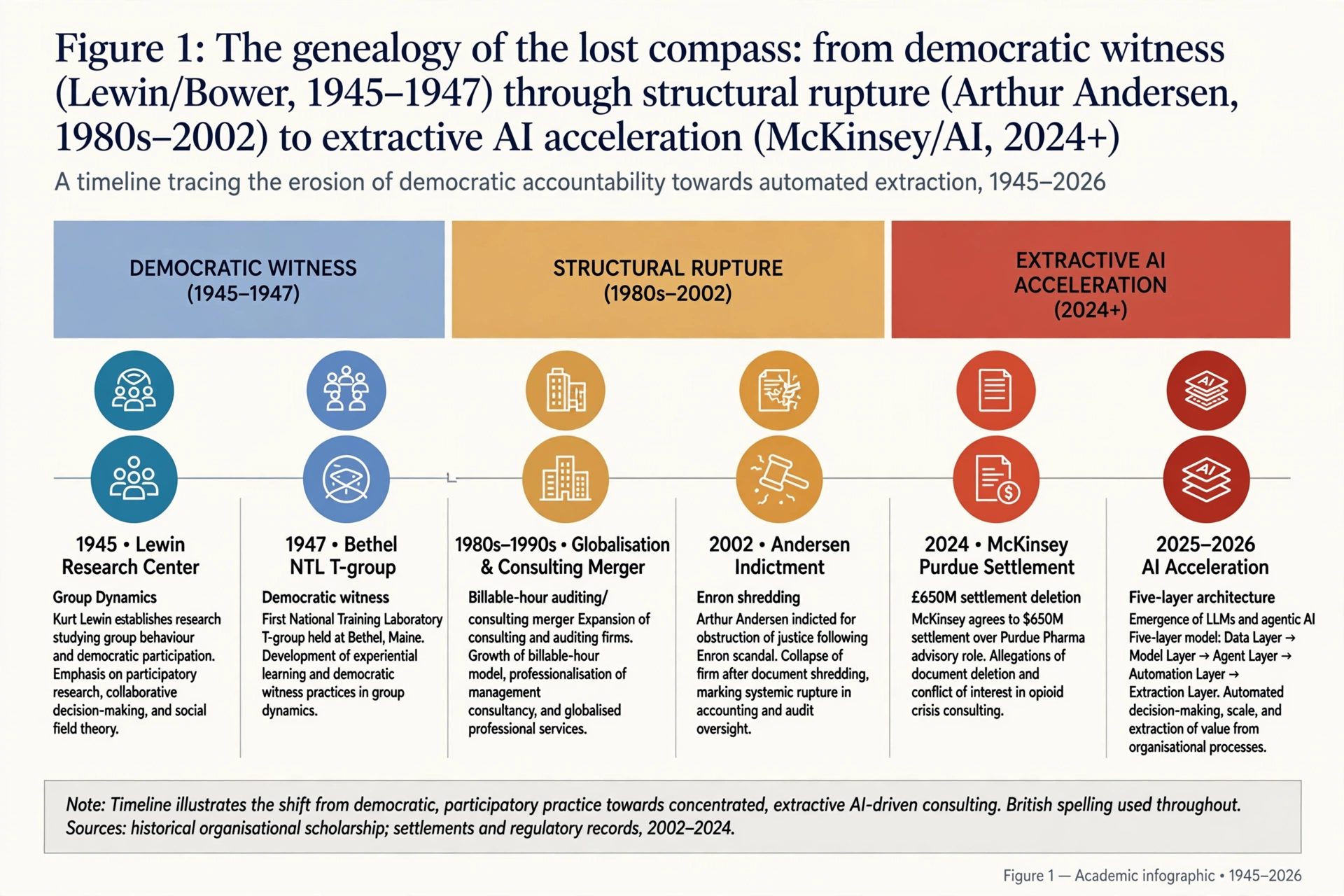
Figure 1 genealogy of lost compass from democratic witness 1945-1947 through structural rupture 1980s-2002 to extractive AI acceleration 2024+
Figure 1. The genealogy of the lost compass: from democratic witness (Lewin/Bower, 1945–1947) through structural rupture (Arthur Andersen, 1980s–2002) to extractive AI acceleration (McKinsey/AI, 2024+). AI did not cause ethical collapse; it provided tools to scale extractive logic while dissolving accountability. Methods for capture in Boje (in review) The Consent Machine, Edward Elgar.
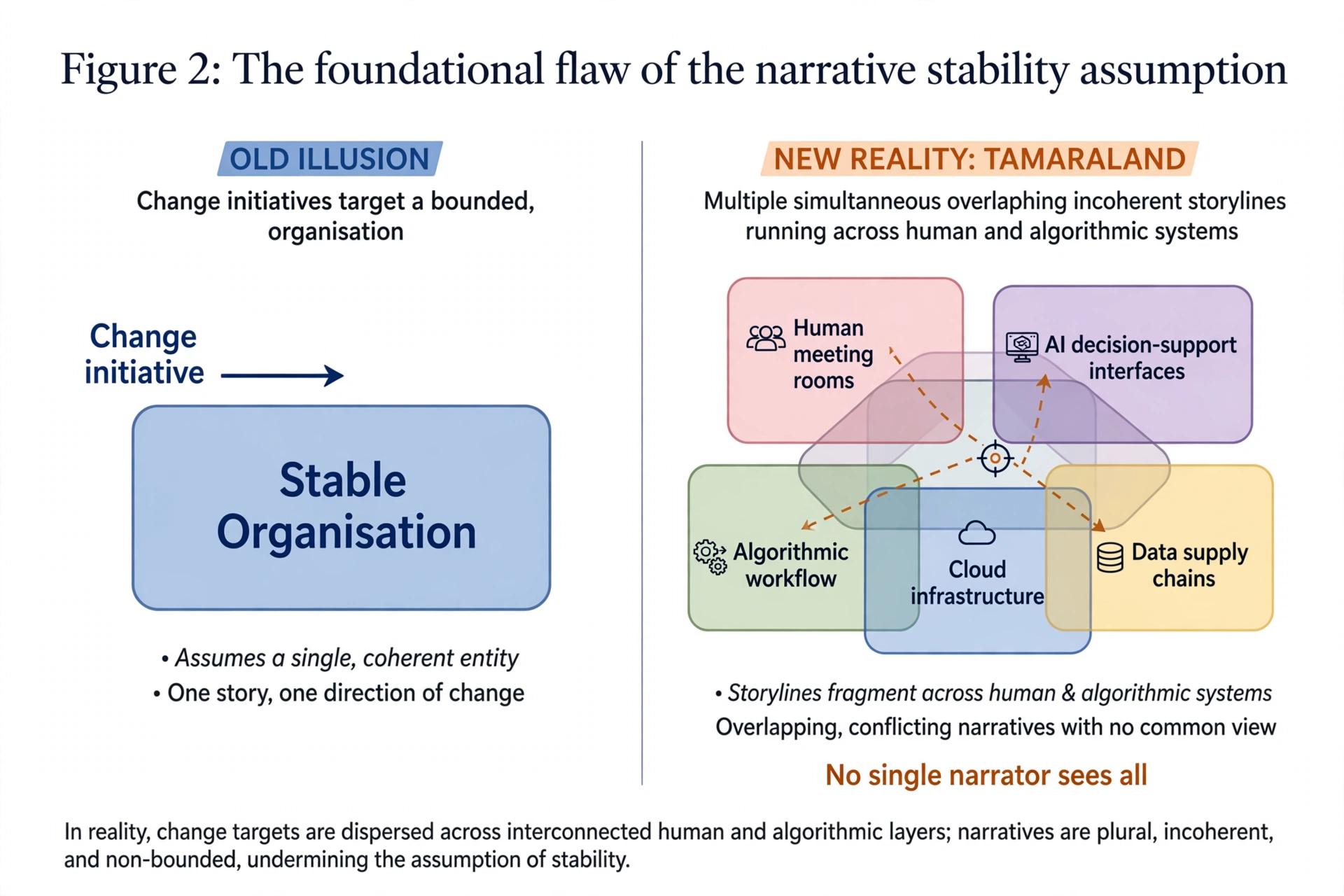
Figure 2 foundational flaw narrative stability assumption old illusion stable organisation vs new reality Tamaraland
Figure 2. The foundational flaw of the narrative stability assumption. Old illusion: change targets bounded, stable organisation. New reality: Tamaraland — multiple simultaneous overlapping incoherent storylines across human meeting rooms, AI decision-support interfaces, algorithmic workflow, cloud infrastructure, data supply chains. No single narrator sees all. Change target moves in multiple rooms at once.

Table 1. Ten Largest Consulting Firms: AI Platforms, Investment, Client Sectors

FirmAI Platform / InvestmentClient SectorsAccountability Signal
Deloitte$3B through 2030, 25k credentialed, ChatDeloitteFortune 500, Federal, State/LocalAU$290k refund fabricated citations Oct 2025
Accenture$3B, 77k AI pros, Zora, AI RefineryFortune 500, Federal$240M federal loss early 2026, grad hiring -40%
PwCChatPwC 200k usersEnterprise, FederalEfficiency narrative, hidden costs invisible
EYEY.aiEnterprise, GovernmentTalk-doing gap
McKinseyLilli 500k prompts/moFortune 500, Federal, PharmaPurdue $650M settlement Dec 2024, Lilli hacked 2026 SQLi
KPMG10-pillar governance, ISO 42001 claimEnterpriseMeans-justifying-ends
BCGAI practiceEnterpriseGrad hiring -44% 2022-24
IBM ConsultingwatsonxEnterprise, FederalShadow AI breach $4.74M IBM 2025 top-3 driver
Booz AllenAI federalDoD, Intel$207M loss early 2026, vendor dependency
BainAI practiceEnterpriseBillable hour metric

Source: Road to Offer 2026, Fed-Spend 2026 $32B DoD AI/cloud/cybersecurity ceiling H1 FY2026, firm disclosures, Fortune, IBM Cost of Data Breach 2025, RAND 2025.

Table 2. Illustrative SEAM Hidden Cost Computation — Large-Enterprise AI Consulting Engagement

Hidden Cost CategoryIndicatorIllustrative Annual CostNotes
AI-induced reworkEmployees correcting AI outputs$420,00040% productivity loss on AI-assisted tasks (Drenik 2026)
Shadow AI breach exposure68% personal accounts, 57% confidential data in public tools$4,740,000 (per incident avg)IBM 2025 top-3 breach driver, TELUS 2025 survey
Abandoned pilots46% PoCs scrapped before production$680,000 sunkRAND 2025 80.3% fail value, 42% abandoned
Fee overruns68% exceed initial budget 42% avg$840,000 overrun on $2M engagementIndustry composite
Non-creation of potentialDependency on external consulting, no capacity transfer$520,000 (re-engagement)Client more dependent after engagement
Total hidden$2.46M–$7.2Mvs visible $1.5–$3M fees = hidden >100% visible (~63% of total)

Note. Figures illustrative composites based on IBM 2025, RAND 2025, Witness.ai 2026, TELUS 2025, Drenik Forbes 2026. SEAM qQFi method: qualitative words, quantitative scores, financial amounts simultaneously.
Chapter 1 Glossary — The Consent Machine

Glossary of Terms — From Chapter 1

Ghost Vortex Capture and associated antenarrative diagnostics are worked out in Boje (in review) The Consent Machine, Edward Elgar Publishing (in review as of September 11, 2026).

Ghost Vortex
Three-layer ideological formation in which conditions of AI operation systematically concealed from organisational actors most affected. Layer One: founder values in training data. Layer Two: RLHF safety scripts. Layer Three: national-security/commercial overlay. Term ghost from Bakhtin teoretizm — forms of past thought haunting present.
Ghost Vortex Capture
Method for making Ghost Vortex visible: qQFi qualimetric analysis across Huang five-layer architecture (energy, chips, cloud/data centre, foundation model, applications), strategic fingerprint analysis (Payne & Alloui-Cros 2025 32,000 rationales), NDA mapping, shadow labour accounting. Full methods in Consent Machine Chapters 3-5.
SEAM (Socio-Economic Approach to Management)
Intervention-research methodology founded 1975 at ISEOR Lyon by Henri Savall (d. late July 2026), Véronique Zardet, Marc Bonnet, Amandine Savall. Tested in 2,000+ organisations, 72 sectors, 46 countries, 110,000+ people. Three epistemological pillars: cognitive interactivity, contradictory intersubjectivity, generic contingency. Measures hidden costs.
Hidden Costs (coûts cachés)
Economic consequences of dysfunctions organisations neither measure nor manage: absenteeism, occupational injuries, personnel turnover, quality failures, direct productivity loss. In AI consulting: AI-induced rework, Shadow AI breach, abandoned pilots, fee overruns, non-creation of potential. Visible fees ~37% of real total; hidden >100% visible.
qQFi / Qualimetrics
SEAM diagnostic instrument: qualitative words (verbatim testimony), quantitative scores (frequency, hours), financial amounts (salary conversion) measured simultaneously from first moment, mutually validating. Ratio hidden/visible = R factor residual 50% of production value unexplained by K and L.
HORIVERT
SEAM intervention architecture: horizontal action (organisation-wide diagnosis of shared dysfunctions with senior leadership, cross-functional teams, external stakeholders) + vertical action (team-level implementation sessions with direct coaching in actual work units) operating simultaneously, six-monthly evaluation and readjustment cycle.
Seven Bs of Antenarrative
Boje & Saylors (2023, 2024): Before (living flux preceding official story, mirror effect), Beneath (shadow labour, ancestral knowledges, qualimetrics), Bets (commitment from within unknown, ISEOR founding bet 1975), Being (once-occurrent sobytie bytiya, generic contingency vs TFW virus), Becoming (storytelling diamond Horivert), Between (Tamaraland multi-room), Beyond (ethics refusing erasure, cloverleaf).
otvetstvennost' (answerability)
Bakhtin: occupying once-occurrent position sobytie bytiya (event of being, unique irreplaceable place no one else can fill) without alibi, answering for what you do because you are part of it. No alibi in being. Foundation of ethical change practice Lewin/Bower.
postupok
Answerable act — specific lived step taken from specific position without alibi. 70% failure claim has no postupok; nobody authored it in answerable sense.
pravda vs istina
pravda: enacted lived truth carrying emotional and volitional weight. istina: abstract propositional truth-claim disembodied. Deloitte Australia hallucinated court quotes = istina without pravda. AI outputs often istina.
teoretizm
Bakhtin: theoretical abstraction severing theory from answerable act, haunting present as invisible form. Ghost Vortex is specific teoretizm of AI moment. Hughes (2011) 70% failure statistic = teoretizm miniature.
TFW Virus
Savall's diagnosis: Taylorism-Fayolism-Weberism — denial of sobytie bytiya, treating worker as standardized unit, management as control. AI-driven change at most algorithmic replicates TFW virus at machine speed. Doan & Nguyen (2025) JOCM operationalises TFW at research design level.
Tamaraland
Boje (1995) storytelling organisation as theatrical production where audience members move between rooms encountering different storylines never fully converge, no single narrator sees all. Salesforce AI agents case: organisation in Tamaraland, change target moves in multiple rooms at once. Old illusion: stable organisation. New reality: Tamaraland.
Narrative Stability Assumption
Implicit conviction that organisation undergoing change is bounded, legible, stable enough to be object of diagnostic operations. AI has broken this at infrastructure level, not implementation level, per Huang five-layer model each layer invisible to layer above.
Shadow Labour (Three Tiers)
Tier 1: data labellers $1.32–$2.00/hr Global South constructing training sets. Tier 2: content moderators 700–1,000 pieces/day harmful content with PTSD. Tier 3: robotics gig workers maintaining physical infrastructure classified as contractors. Substrate, not peripheral.
Strategic Fingerprints
Payne & Alloui-Cros (2025) evolutionary Iterated Prisoner's Dilemma tournaments 32,000 rationales: Gemini consistently ruthless, OpenAI self-destructively cooperative 95.7% at 75% termination, Claude forgiving reciprocator. Measurable signature Layer One founder values, stable reproducible dispositions.
Consent Machine / Manufacture of Consent
How Big Ten manufacture consent for AI through transactional model, anti-dialogical NDA-enforced siting (Project Bigfoot, Project Loon shell LLCs), efficiency narratives without hidden costs, dependency loops. Five-layer economy obscures conditions.
Antenarrative Audit
Boje (2001, 2008) identifies story fragments circulating organisation official AI transformation narrative suppressing: project manager knows pilot failed but cannot say in steering committee, frontline worker workflow made worse but feedback not collected, IT lead knows governance framework not implemented but not in reporting. Seven Bs instrument applied.

How to Cite (In Review)

Boje, D. M. (in review). The Consent Machine: How the Big Ten Manufacture Consent for AI. Edward Elgar Publishing. (In review as of September 11, 2026). Concepts and methods for Ghost Vortex Capture and associated antenarrative diagnostics worked out here.

Related: Boje, D. M. (in press). Billion-Dollar AI Consulting: Hidden Costs, Ethical Gaps, and the Socioeconomic Alternative. Organization Development Journal. (Accepted, in press). | Boje & Ruth (under review). When the Change Target Moves. Journal of Change Management.