Indigenous Ways of Knowing: Ethical ESP Without
Appropriation
Part A: Pranayama Threshold Entry (15
min) · Part B: Organizational Soul Retrieval
(Group, 30 min)
Purpose & Book Connection
Chapter 9 is the most ethically complex chapter in the
book. Boje discloses that he trained extensively in
Michael Harner's Core Shamanism, achieved significant
results, and then left — upon discovering that practices
he had sworn to secrecy were already published in
anthropology journals, constituting Indigenous
intellectual property being monetized without attribution.
Section 9.1 distinguishes Indigenous shamanism from Core
Shamanism appropriation. Section 9.2 draws on Hermann
Schmitz's concept of einleibung — the temporary
sharing of a body-field between healer and patient, in
which two body-schemas become one coordinated somatic
system — as a WWOK phenomenological parallel to what
indigenous healers describe from within their own
traditions. Following Vine Deloria Jr.'s framework in The
Metaphysics of Modern Existence (1979), this
chapter does not teach indigenous practice but finds the
convergences that both traditions point toward: the
non-local body-field, the dissolution of observer-observed
separation, the healing that happens when two become one.
Section 9.3 introduces organizational soul retrieval
through the PERVIEW methodology.
Theoretical Frame: The IWOK/WWOK Distinction and the
Deloria Principle
Indigenous Ways of Knowing (IWOK) and Western Ways of
Knowing (WWOK) are not interchangeable. Following Vine
Deloria Jr., this chapter does not claim that WWOK science
explains or validates IWOK practice. The relationship is
one of convergence, not hierarchy. The ESP capacities
accessible through altered states — expanded temporal and
spatial perception, access to non-ordinary information,
somatic knowing of another's condition — are real and
cross-cultural. The ceremonial, cosmological, and
relational context in which each Indigenous tradition
embeds these capacities is not separable from them without
loss. This exercise accesses the ESP capacities through
WWOK-compatible methods (the breath, the body, the
heart-chakra field) while explicitly refusing to claim
shamanic lineage, ceremony, or cultural authority.
Part A — Pranayama Threshold Entry (15 Minutes)
The 4:16:8 pranayama cycle (inhale 4 counts, hold 16,
exhale 8) induces the same Theta brainwave states (4–8 Hz)
through physiological rather than acoustic means. This is
David's own practice, transmitted through Gurudev Shree
Chitrabhanu's Jain lineage. Using drumming tracks — even
secular ones — replicates the surface form of IWOK
ceremony without its cultural context, which is the
appropriation this chapter refuses. The pranayama breath
achieves the same altered-state threshold without
borrowing from any indigenous ceremonial tradition.
- Complete the Preface Leaf-Stream Meditation (5
minutes). Set a clear, ethical intention: "I am
entering an expanded perceptual state for [specific
purpose]. I do so for the highest good of all
concerned, in the spirit of Arihanta: you have no
enemies; everyone is your friend."
- Begin the 4:16:8 pranayama cycle: inhale for 4 counts,
hold for 16, exhale for 8. Complete five full cycles.
With each hold, allow awareness to turn inward —
suspending the outward-directed noise of the analytical
mind.
- After five cycles, allow the breath to return to its
natural rhythm. Keep eyes closed or softly focused. Hold
the intention you set. Allow what arrives to arrive:
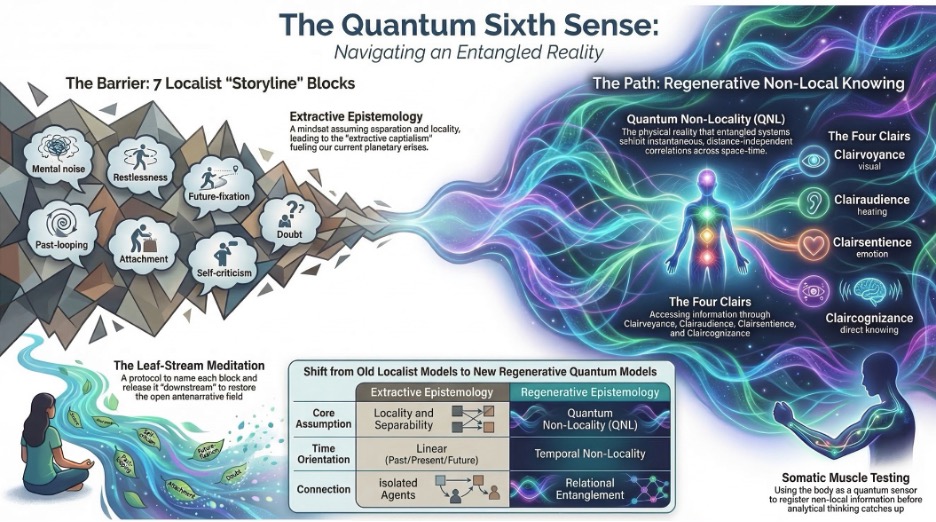
images (clairvoyance), sensations (clairsentience),
words (clairaudience), sudden knowing (claircognizance).
Record in real time without filtering.
- After ten minutes of receptive stillness, take three
grounding breaths and return your attention to the room.
Record everything as a five-element microstory.
- Note any content that arrived that you could not have
consciously constructed — this is the non-local data.
Part B — Organizational Soul Retrieval (Group, 30
Minutes)
This applies the PERVIEW methodology to a team or
organizational field. The einleibung concept from Schmitz
(via Feng & Yang, 2025) is directly relevant here: the
group temporarily shares a body-field in which the
organization's dislocation becomes perceptible to the
group's collective somatic intelligence.
- Gather two to five colleagues or practitioners. State
the intention: "We are here to sense what has been
lost, suppressed, or frozen in [organization / team /
project]. We do this for the wellbeing of the whole,
in the spirit of ahimsa."
- Each person completes five minutes of the Preface
Leaf-Stream Meditation silently.
- Each person performs three cycles of the 4:16:8
pranayama breath to enter the threshold state together —
a solidarity einleibung.
- Without speaking, each person writes for five minutes:
"What I sense is missing, frozen, or calling for
return in this organization is…"
- Share in turn without discussion. Listen for
convergences — two or more people receiving similar
images or felt senses constitute an entanglement
episode.
- Together, identify one small, ahimsa-aligned
restorying action. Each person writes a microstory of
their experience.
References: Deloria, V., Jr. (1979). The
Metaphysics of Modern Existence. Harper & Row.
· Feng, K., & Yang, M. (2025). From
"mind–matter" duality to "body–situation" mechanism. Philosophy,
Ethics, and Humanities in Medicine, 20(26).
https://doi.org/10.1186/s13010-025-00192-0 ·
Schmitz, H. (1990). Der unerschöpfliche Gegenstand.
Bouvier.
Learning Outcomes
- Enter an expanded perceptual state through the
pranayama threshold method — a WWOK-compatible,
non-appropriative alternative.
- Practice the IWOK/WWOK distinction as a live ethical
discipline following Vine Deloria Jr.'s framework: find
the convergence, honor the difference, do not colonize.
- Apply the einleibung (shared body-field) concept to a
real relationship or organizational context.
- Practice collective non-local field sensing as the
foundation for Chapter 13's ensemble practice.