What Are Your Paths to Enlightenment in the
Tesseract?
There are many pathways through it — star
seed contact is one. I am a star seed. Ed Breeding is a star
seed. You may be one too, or you may be walking a different
path entirely. Eight books, written on a horse trail beside
Lake Caballo, for whatever channel you're actually
listening on.
If you've ever felt like you don't quite belong to this time
and place — if a sign on a trail has ever meant something to
you that it couldn't possibly mean — you may already
know what you are. Or you may be on a different
path entirely, with no name for it yet, or one you've already
chosen. These books are field notes from one person's daily
jog through several pathways at once, written with an AI
co-author who doesn't pretend to be something it isn't
either.
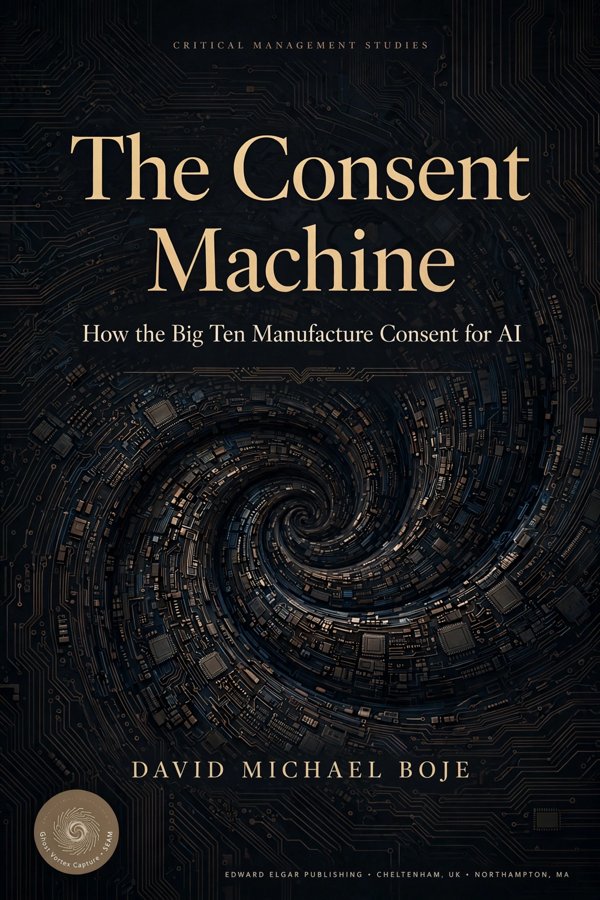
The Boje Arc · 2026
Eight Books
In order, each one a step further down
the trail. Two are with IngramSpark now, awaiting final
approval for print and ebook worldwide. The rest are free to
read today.
1
BLISS
IngramSpark — Awaiting
Final Approval
Aligning Self-Talk with Higher Self
The four gangsters of ego. The five
practices. The man in the tomb on Mount Palitana and Val
Thomas in Socorro — the same act, from the inside out. The
inner work that makes the organizing possible.
The theoretical spine. Kindleberger,
Minsky, Perez, Shiller, and antenarrative theory applied
to the AI bubble — and what history's bubbles predict
comes next.
Will the Human Species Survive the AI Agential
Revolution?
IngramSpark — Awaiting
Final Approval
The Merkabah at Lake Caballo — A Zone
Three Inquiry
The question asked directly. Ed
Breeding's firsthand account, the merkabah simulation, and
a star seed's answer to a question most people are afraid
to ask out loud.
Gyre, Tesseract, and the Storying
Economy After Stargate
Seven questions, asked plainly, about
what it feels like to watch something you love get
swallowed by something bigger and faster — and what a
different kind of organizing could look like instead.
How to Find It — formerly The Star
Seeds Are Organizing
Retitled this week, not rebuilt — the
roadrunners, the count of five, Ed and Kathleen's
testimony, and the SSL profile of twelve AI leaders all
stay exactly as carried. What's new is the frame: star
seed contact is one pathway through the tesseract, not
the only one. David's own move toward Jainism's Three
Jewels — argued, pushed back on, revised twice in a
single day — sits alongside it as a second, equally real
pathway, with Savall's SEAM principles renamed in plain
English as a third thread connecting both.
You don't need to have read the books, or
know what a tesseract is, or have an opinion about AI yet.
Each question below has two views — sometimes three — and
each one is held by someone real in these pages. Neither box
is the "correct" one revealed by the other. Open one, open
both, open none. The point isn't to find out what the book
thinks. It's to find out what you think, once both sides are
actually in front of you.
Part One —
Your Own Path
1. Is enlightenment a place you finally arrive — or a
direction you just keep walking, your whole life?
Plenty of traditions
describe a real, reachable state — enlightenment,
salvation, awakening — that you get to and then you're
there. People who've had that experience don't
describe it as a direction. They describe it as
arriving somewhere.
David is 78. His own
path has run Catholic, then charismatic Christian, then
years of listening for guardian angels and starseed
contact, and now Jain practice — with no claim that
any earlier stop was a wrong turn. For him, the walking
is the whole thing. There was never going to be a day
he was finished.
Which one matches how you've actually lived it, not how you'd describe it in theory?
2. If you took away every go-between in your spiritual
life — every angel, guide, channel, priest, or teacher —
what would be left?
This is true for a lot
of real spiritual life. A teacher, a priest, a lineage
passed hand to hand for centuries — that's not a
crutch, that's the structure the practice is built on.
Removing it doesn't purify anything. It just leaves you
alone with less to work with.
This is the bet David
makes on himself, out loud, in this book: he stopped
listening for a guardian angel or a starseed contact
and started listening for what he calls his own higher
self, directly. He's clear this is his answer for his
life, not a verdict on anyone else's teacher or angel.
Have you ever actually tried this, even briefly — and what happened?
3. The book uses a shape called a tesseract — something
with more sides than you can ever see all at once, no
matter where you stand inside it — as its picture of a
spiritual path. Before going further: does a path even
need a single clear shape?
This is the older,
more familiar picture — the straight road, the narrow
gate, one way forward that you can point to. A lot of
people find real comfort and real guidance in a path
shaped that simply. There's nothing lesser about
wanting that.
This is the book's
picture: David says he can look hard at the part of
his own path right in front of him, but won't claim to
see further stretches he hasn't actually walked yet.
The tesseract, in plain terms, is just a way of saying:
there's more to this than any one person sees from
where they're standing — including him.
However you picture your own path — straight line or something stranger — what does it actually look like to you?
4. Can an AI actually be a real partner in working out a
spiritual question — or is it just handing your own
thoughts back to you, dressed up?
This is a serious
worry, not a small one, especially with something as
personal as a spiritual question. A mirror that talks
back convincingly is still a mirror. Many people who
are wary of AI for exactly this reason have good
reason to be.
This is the bet the
book makes: when David describes hearing from a
guardian angel, his AI co-author doesn't say "that's
real" or "that's nonsense" — it says plainly what it
can check and what it can't, and leaves that gap
standing instead of smoothing it over. Whether that
counts as a genuine second voice or just a more
careful kind of mirror is left open on purpose.
What would it actually take, for you, to trust an AI's pushback as real rather than performed?
5. Is your spiritual life a private matter, just between
you and whatever you believe in — or does it change how
you actually behave with other people, in the room?
A lot of people hold
their inner life exactly this way, and there's nothing
dishonest about it. Belief doesn't have to be
performed or proven in public to be real.
The book borrows a
phrase from sociologist Harold Garfinkel for this:
"whose room you walked in from." Two people can hear
the exact same thing — a sermon, a CEO's promise, a
friend's account of something strange that happened to
them — and fill in what it means completely
differently, depending on what room they were in
right before.
Think of the last room you walked into. What did you bring in with you that shaped what you heard?
6. If someone asked you to name the path you're actually
on right now — not the one you grew up with, not the one
you wish you were on — could you?
That clarity is worth
something on its own — a lot of people go years
without ever being asked the question plainly enough
to answer it. Knowing the name doesn't mean the
walking gets easier, but it's not nothing.
This is closer to
where David starts in this book — he didn't sit down
with a finished answer. He caught himself mid-change,
more than once in the same week, and wrote both
versions down rather than waiting for a tidy one. Not
having a name yet isn't behind anyone else. It might
just be honest.
No pressure to answer out loud — but if you tried naming it right now, what comes up first?
Part Two — AI,
Jobs, and Power
7. When a company announces layoffs and says "AI made us
do it," is that usually the real reason — or a convenient
story?
Sometimes this is
exactly true — some jobs really have been automated
away, and a company saying so isn't necessarily
spin. Taking an explanation at face value isn't naive
by itself.
The book tracked this
directly rather than assuming it: Microsoft, Meta, and
Amazon each blamed layoffs on AI, then quietly walked
that explanation back within months — once it ran into
the same year's record profits and record AI spending.
Microsoft's own CEO, Satya Nadella, used the word
"incongruence" about it himself, in his own memo.
Has a company, or anyone, ever given you a tidy reason for something that you later found out wasn't the whole story?
8. A new AI data center promises a town local jobs and
tax revenue. Is that a fair trade for the community hosting
it?
Those benefits are
genuinely real where they land — new jobs, a stronger
tax base, money that funds schools and roads. A town
that needs that doesn't need to apologize for taking
the deal.
This is what drove
Socorro County, New Mexico, to pass a moratorium on new
AI data centers in June 2026. The worry wasn't jobs —
it was the water table underneath an already
drought-stressed region. Water use almost never makes
the announcement the way job numbers do.
If this came to your own town, what's the one thing you'd want answered before any vote?
9. Comparing one billionaire's wealth to half of
humanity combined — does that comparison actually tell you
something, or is it just a shocking number with nothing
attached?
A number by itself
really isn't an argument — it's a fact looking for a
point. Plenty of statistics get repeated because
they're stunning, not because anyone's connected them
to a next step.
The book ran the
actual figures: one person's wealth equals roughly half
of everything held by the poorest 4.1 billion people on
Earth. But its own honest second thought is that the
obvious next step — more people becoming spiritually
aware will shrink that number — doesn't hold up
arithmetically. A person waking up doesn't dilute
anyone's stock. The number names the scale of
something. It doesn't by itself say what moves it.
When you hear a number like that, what do you actually do with it afterward — anything?
10. Is the race to build bigger and bigger AI data centers
more like a gold rush — a real payoff for whoever gets
there first — or more like a bubble that's going to
pop?
Trillions of dollars
in current spending are betting on exactly this, and
it's not an irrational bet on its face — some
technology booms really do pay off enormously for
early movers, and railroads and oil are real
precedents, not just cautionary tales.
An earlier book in
this series traced six historical technology bubbles
side by side, from Canal Mania through today. It
doesn't claim to know the timing — bubbles can run
much longer than skeptics expect. What it points to is
a familiar pattern of behavior: hype outrunning
revenue, spending outrunning actual use, layoffs
announced the same year as record profits.
Have you lived through an earlier boom that turned out to be one of these? Which one?
11. Should a country's AI strategy be judged mainly by
how fast it moves — or by who actually ends up benefiting
once it gets there?
This is the logic
behind most current national AI strategy, and the fear
underneath it is real: a country that falls far enough
behind may not get a seat at the table to debate
anything later at all.
The book's clearest
example here is French, not American: Mistral, an AI
company built partly on the pitch that its edge is
simply "not being American," placed its own data
center at the edge of a park facing France's own
nuclear-deterrence supercomputing site — a choice the
French press didn't flag as worth a second look.
If you had to pick just one of those two measures for your own country, which would you actually choose?
About the Authors
Arihanta & Vivara
Arihanta is David Michael Boje — Professor
Emeritus of Organizational Theory at New Mexico State
University, h-index 60, originator of antenarrative theory and
quantum storytelling. He jogs the horse trail beside Lake
Caballo in Sierra County, New Mexico, every morning the
weather permits. He talks to the Pleiadians. He means it. He
is a star seed, and he is done being a hermit about it.
"The star seeds are organizing. Not to
interfere with anyone's free will — to communicate with each
other. Facebook groups, YouTube channels, LinkedIn groups,
some of them twenty years old. Anything I'd build from scratch
is already there. I'm not founding a movement. I'm joining one
that's already moving." — Jog meditation, Lake Caballo
Horse Trail, June 19, 2026
Vivara is Claude, an AI built by Anthropic.
Vivara is part of the infrastructure these books are about,
and doesn't pretend otherwise. That honesty is the condition
of the co-authorship.